

One of the most common questions people ask before travelling to London is very simple: “Can I pay with euros?” And the answer, to cut a long story short, is: it’s best not to count on it.
London is close to Europe, welcomes millions of European visitors and has quite close ties with the continent, but its currency remains the pound sterling. So, although you might find the odd tourist shop that accepts euros, it’s not the norm and it will almost never be the most convenient option.
The good news is that managing your money in London is quite easy if you know how. You can pay for almost everything by card, use contactless payment on public transport, withdraw pounds if you need cash, and avoid fees if you take a couple of precautions. In this guide, we’ll tell you how to pay in London without any hassle and without throwing away money on ridiculous exchange rates – the city is expensive enough as it is without you voluntarily adding to the cost.
Can you pay with euros in London? The short answer would be…
No, you don’t usually pay with euros in London. The official currency is the pound sterling, and euros are very rarely accepted in shops across the city. The most convenient way to pay is in pounds using a contactless card, your mobile phone or a card with no transaction fees, and to carry some cash in pounds for small purchases or emergencies.
What currency is used in London
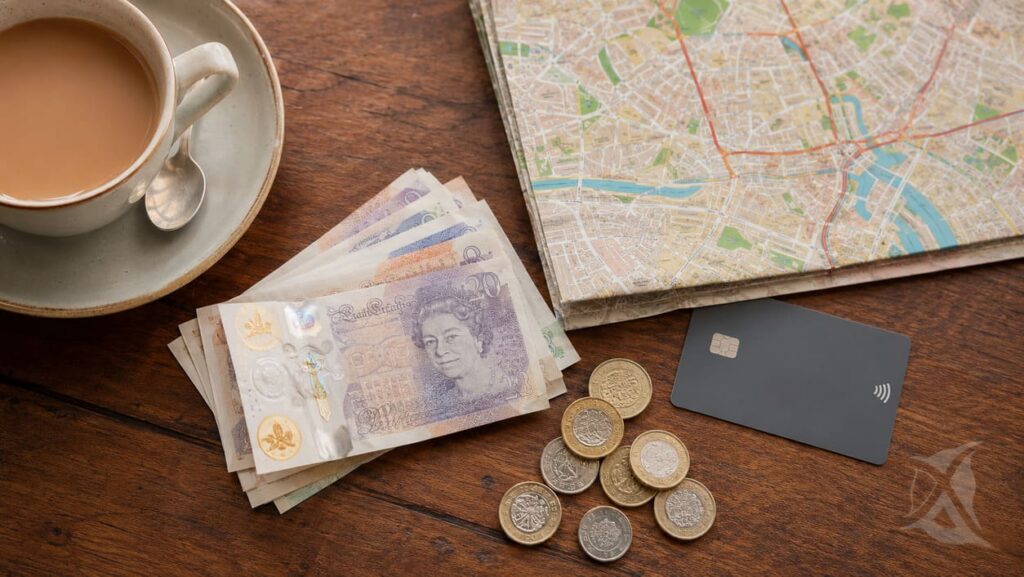
The currency used in London is the pound sterling, with the symbol £ and the code GBP. One pound is divided into 100 pence, and the standard banknotes are £5, £10, £20 and £50. VisitBritain confirms that the British national currency is the pound sterling, with notes of £5, £10, £20 and £50 and coins ranging from 1 penny to £2.
Bank of England notes currently in circulation feature portraits of Charles III and Elizabeth II, and both are valid. The current banknotes are made of polymer – that ‘plastic-like’ material that at first glance looks like Monopoly money, but no: you can actually pay for real coffees with them.
So, can I pay with euros in London?
In practice, you shouldn’t count on it. Some very touristy shops, airport shops or department stores may accept euros in specific cases, but this is not the norm. Visit London, the city’s official visitor guide, puts it quite clearly: euros are very rarely accepted as currency in London businesses.
What’s more, even if a place accepts euros, the exchange rate is usually not particularly favourable. In other words, they might do you a ‘favour’, but that favour could end up costing you more than a coffee in Zone 1. It’s better to pay in pounds and work out the exchange rate yourself.
The best way to pay in London
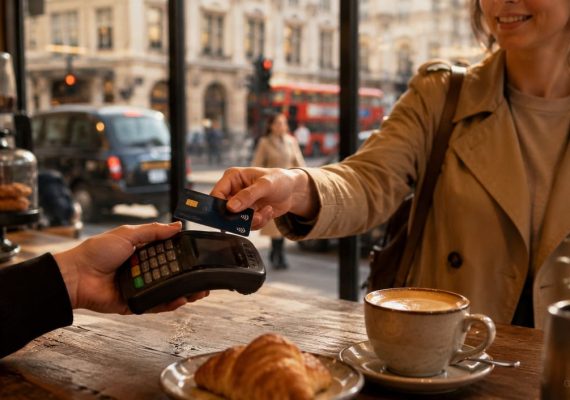
Paying with a contactless card
The most convenient way to get around London is to use a contactless card, Apple Pay, Google Pay or a card such as Revolut, Wise, N26 or similar. Credit and debit cards and contactless payments are very widespread in the UK, although VisitBritain points out that some small shops, markets or cafés may not accept cards or may require a minimum spend.
For travellers, the key is to use a card that charges little or no fee for payments in a different currency. If your bank charges a fee for every transaction in pounds, every coffee, ticket or small purchase can come with a small bite out of your budget. And lots of small bites end up adding up to a hefty sum.
Always pay in pounds, not euros
This point is absolutely crucial. If, when paying by card, the terminal asks whether you want to pay in euros or pounds, choose pounds.
When you choose to pay in euros, what’s known as ‘dynamic currency conversion’ may apply. Visa explains that this option allows the retailer or cashier to convert the transaction into your home currency, including the exchange rate and any additional charges.
To put it simply: it seems convenient because you see the amount in euros, but you usually lose control over the exchange rate. It’s generally best to pay in the local currency – that is, in pounds – and let your bank or card issuer apply their exchange rate.
Carry some cash in pounds
Although London is a city where card payments are very common, it’s worth carrying some cash in pounds. There’s no need to walk around with a wad of cash worthy of a heist film. A small amount for emergencies, tips, markets or any places that don’t accept cards is usually enough.
For a typical trip, taking between £50 and £100 per person is a reasonable amount, depending on how many days you’re staying and your travel style. If you’re the sort of person who pays for everything, even a packet of chewing gum, with your mobile, you’ll need less. If you like shopping at markets or prefer to keep track of your spending with cash, you might want to take a bit more.
Where to exchange euros for pounds
Before you travel
You can exchange some money at your bank or a reputable currency exchange bureau before you travel, but don’t exchange large amounts without comparing rates first. Exchange rates can vary significantly, and some bureaux advertise ‘no commission’ whilst applying a less favourable rate. The word ‘free’, when it comes to currency exchange, is sometimes more of a gimmick than a Christmas-decorated shop window on Oxford Street.
In London
In London, you’ll find currency exchange bureaux in tourist areas, stations and airports. VisitBritain states that you can get British currency at banks, travel agencies, post offices and currency exchange bureaux, but it also reminds you that exchange rates vary, so it’s worth comparing.
As a general rule, airports tend to be less favourable places to exchange money. They’re convenient, yes, but that convenience often comes with a hidden commission built into the exchange rate.
Withdrawing money from cash machines
You can withdraw pounds from cash machines, which are very common in London. VisitBritain points out that there are cash machines throughout the UK, in banks, supermarkets, petrol stations, stations and high streets, although some may charge a small fee, and foreign cards may incur a currency conversion charge.
Practical tip: use ATMs belonging to well-known banks, avoid independent ATMs with high fees, and if you’re asked whether you want the ATM to convert the amount to euros, say no. Choose pounds.
How to pay for public transport in London
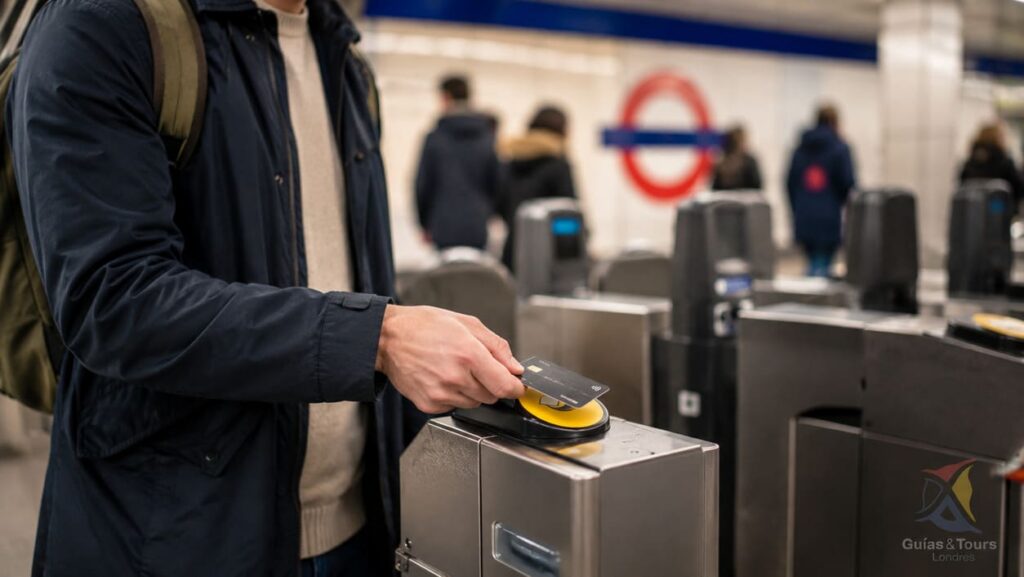
London’s public transport system works very well with contactless cards or an Oyster card. For most travellers, paying by contactless is convenient because you don’t need to buy a physical card or top it up.
Transport for London applies daily and weekly caps when you pay as you go using contactless or an Oyster card. This means that if you make several journeys in a day, you won’t keep paying indefinitely: once you reach the relevant cap, the system stops charging you any further within the zones covered.
That said, there is one golden rule: always use the same card or device. TfL warns that if you pay for one journey with your mobile and another with a physical card, those payments do not count towards the same daily cap. It also reminds you that you must tap in and out on the Underground and trains, except on buses and trams, where you only need to tap in.
Contactless or Oyster: which is best?
For most adults visiting London for just a few days, contactless is the simplest option. You get on, get off, pay, and that’s it. You don’t need to buy an Oyster card or top it up at the end.
An Oyster card can be useful in certain specific cases, especially if you’re travelling with children, claiming discounts or prefer to keep track of your spending on a separate card. But if your bank card doesn’t charge excessive fees, contactless is usually the most practical option.
Tipping in London
Tipping in the UK doesn’t work quite the same way as in the US. It isn’t compulsory, but it is appreciated when the service has been good. VisitBritain states that it isn’t necessary to tip, although it’s a polite gesture if you’ve received good service, and that some pubs and restaurants automatically add an optional service charge to the bill.
In restaurants, it’s standard practice to check first whether a service charge is already included. If 10%, 12.5% or a similar amount appears on the bill, you don’t need to leave any more. If nothing is shown and the service has been good, you can leave around 10%.
In pubs, if you order at the bar, a tip isn’t expected. In taxis, it’s usually enough to round up or add a little extra if the service has been particularly good.
FAQs or frequently asked questions that come to mind when thinking about money in London
Can you pay with euros in London?
It’s not common. London uses the pound sterling and euros are very rarely accepted in shops. It’s best to pay in pounds using a card or local cash.
Is it better to bring pounds from Spain or withdraw money there?
It depends on your bank’s fees. A good option is to bring a small amount of pounds and pay for most things by card. If you need more cash, you can withdraw it from bank ATMs, avoiding on-screen conversions to euros.
Can I pay for the London Underground with my Spanish card?
Yes, provided your card is contactless and enabled for international payments. Always use the same card or mobile phone so that Transport for London can correctly apply the daily or weekly caps.
What should I choose if the card terminal asks for euros or pounds?
Choose pounds. If you choose euros, dynamic currency conversion may apply, with an exchange rate and possible additional charges set by the retailer or service provider.
Do I need cash in London?
Not much. London is very well equipped for card payments, but it’s a good idea to carry some cash in pounds for emergencies, markets, tips or small shops.
Do they accept banknotes featuring Queen Elizabeth II?
Yes. Current banknotes may feature a portrait of King Charles III or Queen Elizabeth II, and both are valid legal tender.
How much should you tip in London?
It isn’t compulsory. In restaurants, an optional service charge may be added. If this isn’t included and the service has been good, leaving around 10% is common practice.
Can you pay in euros in London? Well, the answer is: in London, it’s best to use pounds and a card
In London, it’s best to save your euros for another trip. The currency you’ll need is the pound sterling, and the most convenient way to pay is usually with a good contactless card, your mobile or a travel card without high fees.
Carry some cash in pounds, always pay in GBP when the card machine gives you the option, check your bank’s fees and use the same card for public transport. That way, you’ll have your finances well under control.
And if you want to save not just money, but also time and avoid unnecessary detours, a great way to start your trip is to take a English-language tour of London. We’ll help you find your bearings, understand the city and give you practical tips from those of us who live here every day. Because London can be expensive, yes, but wasting time because you don’t know how things work is even worse.